| Homepage | |||
| Site Map | |||
| Contact us | |||
| Directions | The reference for phased array probes | ||
Search Imasonic

|
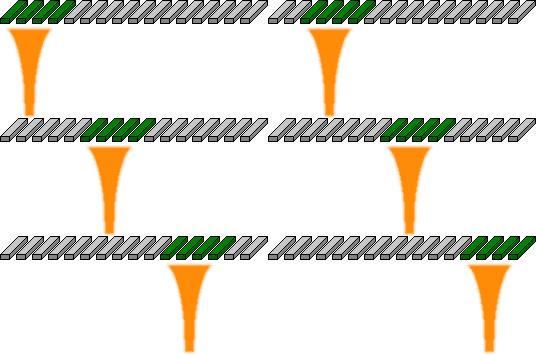
Phased array principle Increased productivity and inspection capabilities The Phased Array concept concerns multielement transducers. Each element of these transducers is connected to a different electronic channel, either directly or through multiplexors, according to electronic device performances. Each element can be activated or not for each shot. The size and the location of the active aperture of a phased array transducer depends on the activated elements. An electronic delay can be applied to each electronic channel when emitting and receiving the signal to/from the transducer elements. The setup corresponding to all the delays of a given shot is called Delay Law. Each delay law defines a different acoustic beam with particular direction, focusing distance and lateral resolution. This technique requires probes with very low acoustic and electric cross coupling between the elements, so that all the elements could be fired independently. Thanks to their 1-3 structure, Imasonic piezocomposite materials are completely adapted to this feature. More >> Electronic Scanning The beam is electronically translated by alternatively firing a given number of elements of a linear or circular array phased array transducer
This technique is an alternative to mechanical translation of a single element probe The advantages are Electronic Focusing The beam is electronically focused by applying symmetrical delay laws to the different elements of a linear or annular phased array transducer.
This technique is an alternative to using several transducers to focus at different depths The advantages are Note : Electronic focusing can be used in addition to a cylindrical, spherical or aspherical mechanical pre-focusing of the transducer Electronic Steering The beam is electronically deflected by applying delay laws to different elements of a linear, circular or matrix array. Linear and circular arrays allow for 2D beam steering, while matrix arrays allow for 3D beam steering.
This technique is an alternative to using different angled transducers The advantages are Note : To optimise beam characteristics, electronic deflection can be used in addition to a mechanical pre-deflection with a wedge |